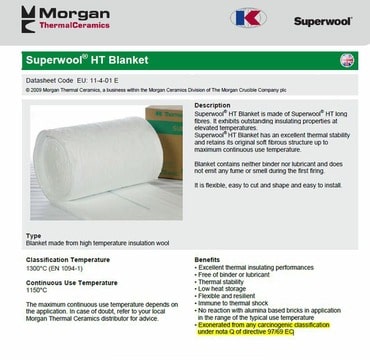
Hier nog een link naar een veiligheids document over superwool:
http://docs-europe.electrocomponents.co ... 1bc3e9.pdf
Omdat de vraag ontstond, wat gebeurt er als het product verhit is, zie dit stukje uit het document:
10.6 - Hazardous decomposition products Upon heating above 900°C for sustained periods, this amorphous material begins to transform to mixtures of crystalline phases. For further information please refer to Section 16.
sectie 16:
Information on after service heated fibres
In almost all applications high temperature insulating wools products (HTIW) are used as an insulating material helping keeping up temperature at 900°C or more in a closed space. As only a thin layer of the insulation hot face side is exposed to high temperature, respirable dust generated during removal operations does not contain detectable levels of crystalline silica.
In applications where the material is heat socked, duration of heat exposure is normally short and a significant devitrification allowing CS to build up does not occur. This is the case for waste mould casting for instance. Toxicological evaluation of the effect of the presence of CS in artificially heated HTIW material has not shown any increased toxicity in vitro. The results from different combinations of factors like increased brittleness of fibres, or micro crystals embedded in the glass structure of the fibre and therefore not biologically available may explain the lack of toxicological effects.
IARC evaluation as provided in Monograph 68 is not relevant as CS is not biologically available in after service HTIW and respirable dust generated during removal operations does not contain detectable levels of crystalline silica.
http://www.iarc.fr/en/publications/pdfs ... /index.php
High concentrations of fibres and other dusts may be generated when after-service products are mechanically disturbed during operations such as wrecking. Therefore ECFIA recommends: a) control measures are taken to reduce dust emissions; and b) all personnel directly involved wear an appropriate respirator to minimise exposure and comply with local regulatory limits.
 Ohshit. Zit ik net mijn schoorsteen er mee in te pakken.